


We would be happy to include you in our market report mailing list. So you won’t miss out on any future issues!

Insurance markets in emerging economies offer enormous potential. However, insurers seeking to enter new markets need more than tailored products: they must first reach the people. Without access to local consumers, there is no access to the local market.
More than half of global insurance premium income is generated in Europe and North America, even though these regions account for less than 20 percent of the world’s population. There is therefore still a significant protection gap in many parts of the world – and considerable scope for development. Those who lay the right foundations today in Latin America, parts of Asia or North Africa, will gain access to the high-potential markets of the future.
But what does this involve? Many insurers develop products tailored to customers’ needs. While this is a key component, it is not enough on its own. The chances of success are higher the earlier the industry gets involved: people in emerging economies tend to take out insurance only once financial services become part of their everyday lives. This requires, above all, broad access to financial services, greater awareness of the value of insurance, and confidence in public institutions. Local insurers can actively help shape these developments by engaging with policymakers, advocating for a stable regulatory framework, cooperating with banks and microfinance institutions, and supporting their evolution. This creates solid ground for new insurance growth markets to emerge from and grow step by step.
Tarik Aouad, Head of the International Growth Markets Division at Deutsche Rück, takes a global approach: “We support our clients in international growth markets and aim to bring together experience from different regions,” he says. “Practices that are already well established in one market can provide valuable impetus in another. Combined with local expertise, disciplined underwriting and long-term partnerships, this creates lasting value for our clients and for Deutsche Rück alike.”

Source: The Global Findex Database, 2025
Tarik Aouad, Head of the International Growth Markets Division at Deutsche Rück

Bankok, Thailand, man buying fruit at a street stall.
The starting conditions vary from one region to another. In many parts of Asia, financial and insurance markets are currently growing particularly rapidly. Digital identity solutions and mobile payment systems have already given millions of people access to financial services for the first time. “Many Asian countries have the great advantage of being able to build their insurance markets on a digital foundation from the outset,” explains Aouad. “Digital identity solutions, mobile payment systems and data-driven underwriting not only improve efficiency, but also make insurance more accessible and affordable for millions of people.” Younger generations now take digital services for granted, for example.
The market is also undergoing significant change in Latin America. In 2025, the international consulting firm McKinsey even ranked Latin America as the world’s fastest-growing and most profitable insurance market. Brazil, Mexico, Chile and Colombia are leading the way. Property and casualty insurance, particularly property and accident insurance, is currently seeing the strongest growth. At the same time, demand for health insurance is increasing, driven by a growing middle class. Many consumers are discovering insurance as part of their everyday financial lives for the first time.
But before people can take out an insurance policy, certain prerequisites must be in place. “In Latin America, above all, people need a better understanding of the benefits of insurance, clear rules and deep-rooted trust,” says Dr Mariana Vilmondes, designated Head of the Latin America Market in Deutsche Rück’s International Growth Markets Division. Only then will new customer segments and stable market structures gradually emerge.

With 21.2 million inhabitants, São Paulo is one of the world’s most populous metropolitan areas.
The insurance industry in North Africa is also on a steady growth trajectory. Morocco plays a key role, says Laurent Beauregard, Market Head for France, Belgium, Luxembourg and the Maghreb at Deutsche Rück subsidiary DR Swiss: “The country is positioning itself as Africa’s financial hub through its modern Casablanca Finance City and is becoming increasingly attractive to international investors.”

Modern residential and office buildings in Finance City, in the Anfa district of Casablanca, Morocco
However, cultural values shape the market more strongly in North Africa than elsewhere. “Muslims are often sceptical of life insurance because they view it as a gamble on life that is incompatible with their faith,” explains Beauregard. But attitudes are changing: “Gradually, people are recognising the benefits of life insurance with a savings component – they can save while at the same time providing financial protection for their families in the event of death.”
Regardless of how far individual markets have progressed, one thing is clear: A bank account, basic financial literacy and regulatory credibility are essential prerequisites for further developing the insurance business. Only on this foundation can insurance solutions tailored to people’s needs succeed.
Laurent Beauregard, Market Head for France, Belgium, Luxembourg and the Maghreb at DR Swiss
According to a World Bank survey published in 2025, 79 percent of adults worldwide now have an account with a bank or a mobile payment provider, compared with just 51 percent in 2011. However, there are significant differences between regions. In Europe, almost all adults use banking services. Many Asian countries also report rates of more than 80 percent. By contrast, only around 60 percent of adults in Latin America have access to formal financial services, while in North Africa the figure is often less than half. Without access to basic payment services, access to insurance remains out of reach.
India’s Pradhan Mantri Jan Dhan Yojana programme, launched in 2014, provides a striking example of how political determination can transform financial inclusion. The government introduced fee-free accounts with no minimum balance requirement, giving people easy access to government-backed insurance and loans. Within just a few years, more than 500 million new accounts were opened, many of them by people who were interacting with the financial system for the first time.
Such measures set a broader development in motion: “More and more people are learning how to use financial products and gradually building up a financial track record,” explains Aouad. “Digital services also bridge vast distances and reach people in remote areas.” Over time, this builds trust in financial products – and, with it, the willingness to take out insurance.

The new bank account holders under PMJDY, during the Public Information Campaign, at Bungtlang South, Indo-Myanmar Border Village, Lawngtlai, in Mizoram on November 14, 2014
Access to financial services alone is not enough. Equally important are educational initiatives that help people understand financial concepts. For example, through its foundations, the Savings Banks Finance Group supports local financial institutions in Latin America in their professional development, facilitates access to financial services for small and medium-sized enterprises, and provides financial education programmes for the public. Dr Mariana Vilmondes explains: “People in Latin America can only make informed financial decisions and manage their money effectively if they have a basic understanding of financial matters.”

Regional project of the German Savings Banks Foundation for International Cooperation: Improving sustainable access to financial services by strengthening education and association structures in Central and South America. With the brochure “Yo mis finanzas” (“Me and My Money”), women micro-entrepreneurs in Latin America and the Caribbean learn how to manage their money properly.
Regional project of the German Savings Banks Foundation for International Cooperation: Improving sustainable access to financial services by strengthening education and association structures in Central and South America. With the brochure “Yo mis finanzas” (“Me and My Money”), women micro-entrepreneurs in Latin America and the Caribbean learn how to manage their money properly.
The better people understand risks, probabilities and their own financial resilience, the more likely they are to recognise the value of insurance. “Local insurers also have an important role to play in raising general awareness,” emphasises Dr Vilmondes. As long as insurance policies appear complicated, they discourage many people. By contrast, when insurers explain their products clearly and in relatable terms, trust grows and people become more willing to take out insurance.
Dr Mariana Vilmondes, designated Head of the Latin America Market at Deutsche Rück


Trust in banks and insurers is built not only down to people, but also reliable regional regulators. In countries where regulators and policymakers promote transparency and inspire confidence, the insurance market is growing strongly.
Morocco is a good example: The regulatory authority ACAPS has introduced a digital claims management platform, which connects policyholders with insurers, speeds up claims processing and enables policyholders to track the status of their claims at any time. “This sends a clear message: insurance works here,” explains Beauregard. “It also gives people with little previous experience of formal protection confidence in the system.”
Tarik Aouad, Head of the International Growth Markets Division at Deutsche Rück
Although regions are developing at different speeds, they all follow a similar pattern: as financial inclusion grows, so too does the demand for insurance. “Insurance becomes part of everyday life when it is accessible, easy to understand and reliable. This is where many international growth markets offer tremendous opportunities,” concludes Aouad. However, this is not a short-term project, but a task that may take years, if not decades.

Place Assarag, Taroudant, Morocco
Artificial intelligence (AI) is currently the key driver of transformation in the insurance industry. While the impact of AI on customer communication, claims handling and sales has been the subject of much attention, one area of the insurance business has remained relatively under the radar: the impact of AI on property insurance underwriting.
This raises a fundamental question for insurers: Does the use of AI change the insured risk – and, if so, to what extent? AI is now used across a wide range of industrial applications: it controls production facilities, optimises maintenance processes, monitors buildings, detects quality defects, and increasingly, makes autonomous decisions within companies.
AI is therefore a key technology driving the fourth industrial revolution – paving the way for the smart factory. It is accelerating digital transformation in areas such as big data, robotics and the Internet of Things. The widespread use of AI-powered chips, for example in manufacturing, illustrates the scale of the potential risk should faulty AI lead to widespread business interruption.
The challenge for underwriters is summed up by Daniel Hernandez, Senior Underwriter, Facultative Property Business and Property Line Management at Deutsche Rück: “AI is not a standalone risk – it is a cross-cutting technology. The real danger for insurers lies not in individual AI applications, but in the unrecognised aggregation of risk within existing covers.”
The risk is often hidden because AI is embedded in machinery, buildings, control systems and supply chains. However, the consequences can be very tangible when the resulting loss manifests itself in traditional physical forms, such as production downtime, system malfunctions or fire damage. As the underlying cause is often software-based, the boundaries between property, cyber and product liability risks can become blurred. In addition, there is a significant accumulation risk arising from globally deployed AI models, shared cloud infrastructure and common software libraries.
Daniel Hernandez, Senior Underwriter Facultative Property Business and Property Line Management, Deutsche Rück
The question is to what extent these risks are covered under existing policies. This draws parallels with cyber insurance and silent cyber risks. Silent risks are risk exposures within existing insurance covers that are neither explicitly modelled nor clearly addressed in policy wordings, but which may arise as a result of technological, regulatory or societal change. Silent AI is now emerging as a new structural risk, driven by the increasing use of AI by policyholders.
In the case of silent cyber risk, conventional policies have excluded cyber risks in some cases. The US market is already seeing similar discussions around Silent AI. However, exclusions for AI risks remain rare in Europe – at least for now. “Primary insurers must now recognise the strategic significance of Silent AI and review their portfolios for potential AI-related risks,” says Hernandez.


Two examples illustrate where the risks associated with embedded AI in industry may lie, from an insurer’s perspective. Modern smart buildings use AI to control heating, ventilation, lighting, and security systems. Using sensor data, these systems analyse occupancy patterns, energy consumption and climate data, enabling them to make autonomous decisions. Access control systems are enhanced by image recognition, while security cameras analyse movement patterns in real time.
These systems significantly improve efficiency and convenience. At the same time, however, they create new dependencies. Faulty decisions or technical malfunctions can affect fire protection, building safety and operational processes – thereby becoming an insurance risk.
Another example is predictive maintenance. Instead of inspecting machinery at fixed maintenance intervals, AI systems continuously analyse sensor data, such as vibration, temperature and power consumption. Based on historical data, the software calculates the optimal time for maintenance and predicts the remaining service life of individual components.
But what happens if the prediction is wrong? Who is liable if an algorithm fails to detect a critical defect? And how does the probability of loss change when companies rely entirely on AI models to determine their maintenance strategies? To date, such questions have been difficult to answer using historical claims data.


Many primary insurers are currently assessing the extent to which AI-related risks are implicitly covered under existing insurance covers. But how can these risks be quantified? Are there specific, clearly identifiable sources of risk? And can these risks already be managed proactively? “The insurance industry is only just beginning to address AI risks in underwriting,” says Hernandez. There are currently no specific recommendations for action. This makes it all the more important for insurers to first develop an understanding of AI as a cross-cutting technology that will fundamentally transform business and society.
It is also important to closely monitor current market developments relating to AI risk, and to ensure transparency regarding insurers’ own risk exposure. Hernandez is confident that “the industry will rise to the challenges posed by AI and learn how to manage them in underwriting.”
Daniel Hernandez, Senior Underwriter Facultative Property Business and Property Line Management, Deutsche Rück

Founded in 1951, Deutsche Rück is now one of the leading reinsurers in the German market and a trusted partner in around 80 countries worldwide. Yet its beginnings as the reinsurer of Germany’s public insurers in the post-war years were anything but easy.
The history of Deutsche Rück has been shaped by growth and innovation, but also by periods of realignment. Especially in challenging times, it has become clear just how important a stable ownership structure and a shared foundation are. That was already evident when the company was founded. Deutsche Rück was not established to seize a market opportunity, but to meet a specific need.
Of the 43 public insurers, only 24 survived the Second World War. They all faced the same challenge: Individually, they were too small to bear major fire and natural catastrophe risks on a lasting basis. This was because the nationwide risk-sharing arrangements that had existed before the war had collapsed, forcing them to reorganise. The answer was not an individual solution but a collective one: a dedicated reinsurance company backed by all public insurers. On 22 August 1951, “Deutsche Rückversicherung Aktiengesellschaft” was founded in Bernkastel-Kues on the River Moselle. Its founding mission continues to shape the company to this day.

Where it all officially began: The Hotel zur Post in Bernkastel-Kues still exists today. Postcard of Bernkastel-Kues, c. 1910
Where it all officially began: The Hotel zur Post in Bernkastel-Kues still exists today. Postcard of Bernkastel-Kues, c. 1910
After its establishment, Deutsche Rück wasted no time in commencing operations in Hamburg, initially as a subtenant of Hamburger Feuerkasse, occupying just two offices with a staff of only five. The company later moved to its first dedicated office building on Hamburg’s Outer Alster. The 1950s and 1960s were a period of growth for Deutsche Rück. Its growth was driven not by outpacing its shareholders, but by growing alongside them. The post-war reconstruction, the construction boom and the strong position of the public insurers in their core business of building insurance were all directly reflected in Deutsche Rück’s reinsurance business.


One of the first major tests for the public insurers – and therefore also for Deutsche Rück – was the North Sea flood of 1962. The public insurers were, and to a large extent still are, the market leaders in homeowners’ insurance in Germany. As a result, dealing with natural hazards became part of Deutsche Rück’s DNA from an early stage.

The North Sea flood of 1962 demonstrated the scale of natural catastrophe risk at Deutsche Rück. Parts of the Hanseatic city Hamburg were under water at the time. More than 300 people died.
The North Sea flood of 1962 demonstrated the scale of natural catastrophe risk at Deutsche Rück. Parts of the Hanseatic city Hamburg were under water at the time. More than 300 people died.
At the beginning of the 1970s, heavy fire losses and rapidly rising inflation placed an increasing strain on Deutsche Rück's balance sheet. The 1973 oil crisis compounded the situation, bringing the economic upswing to an end and plunging the German economy into recession. For the first time since its founding, Deutsche Rück’s premium income declined.
The thinking was that expanding into international business would not only provide better risk diversification, but also stimulate growth. Deutsche Rück therefore entered the London market. While this delivered growth, it also brought business that generated substantial losses. The asbestos and liability crises of the late 1980s, together with the notorious London reinsurance spiral, only made matters worse. Then, at the beginning of the 1990s, losses from the international business were compounded by the heaviest series of storms Germany had experienced up to that point. The result was the largest – and ultimately the only – crisis in Deutsche Rück's history.

The storms DARIA (Burns Day Storm), HERTA, JUDITH, POLLY, VIVIAN and WIEBKE resulted in the largest loss burden in the company’s history up to that point. The photo shows felled trees caused by WIEBKE near Sauerlach.
The storms DARIA (Burns Day Storm), HERTA, JUDITH, POLLY, VIVIAN and WIEBKE resulted in the largest loss burden in the company’s history up to that point. The photo shows felled trees caused by WIEBKE near Sauerlach.
Looking back, it is clear: The internationalisation strategy was sound in principle – but poorly executed. The company lacked experience in these markets, some of its partners proved problematic, and it had assumed risks that it was unable to fully assess. One important lesson ultimately paved the way for future success: Diversification works only if you truly understand and can accurately assess the new risks involved.
What proved decisive for Deutsche Rück’s future was not the crisis itself, but the response to it. In 1993, a collective rescue effort by all public insurers saved Deutsche Rück and enabled it to overcome the crisis. Its UK operations were discontinued, and the company withdrew completely from active international business.

Everything under one roof, illustration of the building at Roßstraße 166
The crisis became a turning point – and laid the foundations for the Deutsche Rück we know today. The company had to reposition itself – both strategically and in terms of its business focus. In 1989, Deutsche Rück moved from the Elbe to the Rhine. Düsseldorf was increasingly becoming the centre of the public insurers’ supra-regional activities. There, together with the two associations representing the public insurers that still existed at the time, it pooled resources and formed an integrated management and administrative organisation.
At the same time, the market underwent fundamental change: The deregulation of the EU single market in the mid-1990s suddenly intensified competition among primary insurers. The public insurers had to reposition themselves – and needed greater support to do so. This enabled Deutsche Rück to redefine its role: no longer merely as a risk carrier, but as a genuine partner to the public insurers.
The devastating series of winter storms in 1990 once again highlighted the scale of the threat facing the public insurers. A key element of this strategic repositioning was therefore the development of expertise, particularly in the field of natural hazard modelling.
At the beginning of the 1990s, analyses of natural hazards were still relatively imprecise and offered only limited geographical detail. With the establishment of its new NatCat Centre, however, Deutsche Rück began to analyse storm, flood and earthquake risks at regional level in an increasingly systematic and detailed way, incorporating the results into its risk assessments – pioneering work for its time.
The idea behind it: Not merely to pay claims, but to gain a better understanding of risk – making it more quantifiable and therefore more manageable. Today, this expertise is inseparably linked with the Deutsche Rück brand in Germany.

Through its ‘Annual Weather Documentation’ (Sturmdokumentation), Deutsche Rück has been documenting its specialist expertise in natural hazards since 1997. In this publication, natural hazard experts describe and analyse weather events in Germany and provide important background information to help classify these events in terms of both meteorological factors and the resulting damage, and to draw the correct conclusions regarding current and future natural hazard occurrences.
Building on this foundation, Deutsche Rück cautiously re-entered the international reinsurance market. In 2000, Deutsche Rück established its subsidiary, DR Swiss, in Zurich. This marked the first modest step in its renewed international expansion. Since then, Deutsche Rück has remained committed to two key strategic principles: underwriting only those risks it understands and can assess properly, and generating the capital required for expansion from its own resources.

The DR Swiss headquarters on Schweizergasse in Zurich
The DR Swiss headquarters on Schweizergasse in Zurich
In 2005, Deutsche Rück took its next step on familiar ground. It expanded its market presence in Germany, Austria and Switzerland.
In 2009, it entered the markets of Central and Eastern Europe. There, Deutsche Rück operates as a following reinsurer in its core Property & Casualty business.
Over the past five years, it has also successfully expanded its presence in the fast-growing markets of the Middle East, Asia and Latin America. Since 2024, Deutsche Rück has also been writing life reinsurance business successfully in the MENA (Middle East and North Africa) region.


In its anniversary year, Deutsche Rück is active in around 80 countries worldwide. Its history clearly demonstrates what the company stands for today – and will continue to stand for in the future: It is a medium-sized company that has successfully combined tradition with innovation, fosters partnerships with its clients on an equal footing, consciously builds long-term relationships, and is committed to disciplined underwriting, active risk management and clear portfolio management – independent of the capital markets and with the public insurers as reliable and stable shareholders.

Over the past 75 years, Deutsche Rück has come a long way – from a subtenant of the Hamburger Feuerkasse with five employees to a well-established and reliable reinsurer respected throughout the market. At its new headquarters in Düsseldorf, around 280 employees are now continuing this story of success – building on a strong foundation and with a clear vision for the way ahead.

Over the past 75 years, Deutsche Rück has come a long way – from a subtenant of the Hamburger Feuerkasse with five employees to a well-established and reliable reinsurer respected throughout the market. At its new headquarters in Düsseldorf, around 280 employees are now continuing this story of success – building on a strong foundation and with a clear vision for the way ahead.

Find out more about
the company’s history!
We would be happy to include you in our market report mailing list – so you won’t miss out on any future issues! Simply add yourself to the mailing list.

Among other issues, in this edition, we show how structured reinsurance can help primary insurers sustainably secure their financial stability.

Among other issues, in this issue, we look at the liability risk associated with forever chemicals PFAS. What impact do they have and how is the insurance industry dealing with them?

Among other issues, in this issue we explore why the Middle East and Maghreb regions are particularly interesting for life and health insurers.

In this issue we look at the climate insurance protection gap and examine the problems as well as possible solutions.

In this issue, we take a look at how cities can implement intelligent water management to become more resilient to severe and persistent rainfall.

In this issue, we explore topics including the requirements placed on reinsurers by the Nordic markets and the business culture in this area.

In this issue, we take a closer look at questions including why countries in South and East Asia are of particular interest for insurers and reinsurers.

In this issue we look back at the devastating floods in Europe in the summer of 2021.
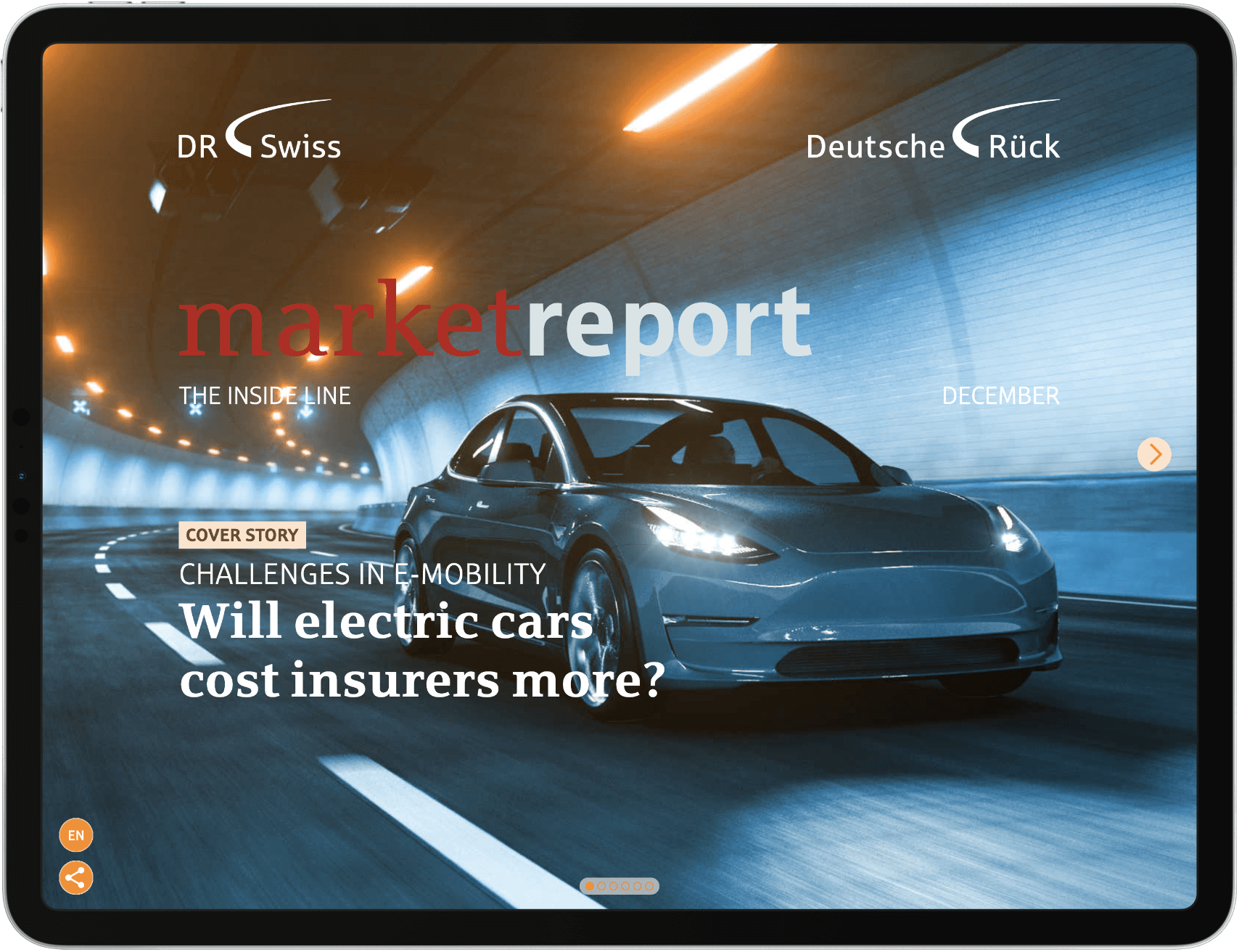
In this issue, we delve into a series of topics, including the growing e-mobility market and the challenges it poses to insurers.

In this issue, Deutsche Rück tackles, among other issues, the question of the importance of personal business contact after the pandemic.
Deutsche Rückversicherung Aktiengesellschaft
Heerdter Lohweg 53
40549 Düsseldorf, Germany
Phone +49 211 4554-01
info@deutscherueck.de
www.deutscherueck.com
www.drswiss.ch
Jan Stepic, Melanie Dahms, Stephanie Embach-Stein,
Babette Sybertz (responsible for contents)
Jasmin Oberdorfer, wortwert Corporate Content;
Dr Marc Surminski, Zeitschrift für Versicherungswesen;
editorial team market report
intellitext SprachenService
www.intellitext.de
ENORM Digital GmbH, Cologne
www.enorm.digital
alamy.de/Bosiljka Zutich; Soma; vasa; Marek Slusarczyk; Martin Bertrand; Peter Forsberg;
Ministry of Information & Broadcasting (India) / GODL-India, via Wikimedia Commons;
stock.adobe.com/happyvector071;
HGEsch/Deutsche Rück/caspar.;
Günther Hachmeister, https://www.lauritzen-hamburg.de/flut_wilhelmsburg.html;
picture alliance / SZ Photo | Luftbildverlag Hans Bertram;
Deutsche Sparkassenstiftung, Florian Kopp;
Deutsche Rückversicherung/Verband öffentlicher Versicherer, Düsseldorf;
Hamburger Feuerkasse
Published in September 2026
Sie verwenden einen veralteten Browser, in dem diese Seite möglicherweise nicht korrekt dargestellt wird.


